
4 Amazing Facts About the Styracosaurus

When we think about dinosaurs with horns and frills, the Styracosaurus may not be the first creature that comes to mind. This beast lived during the Late Cretaceous period, and its name means “spiked lizard.” Learn four more amazing facts about the Styracosaurus!
The Discovery
In 1913, paleontologists unearthed a fossil of the Styracosaurus for the first time. Lawrence Lambe made this discovery in Alberta, Canada. We have since discovered more remains of this dinosaur, including a massive bone bed in the United States.
Its Appearance
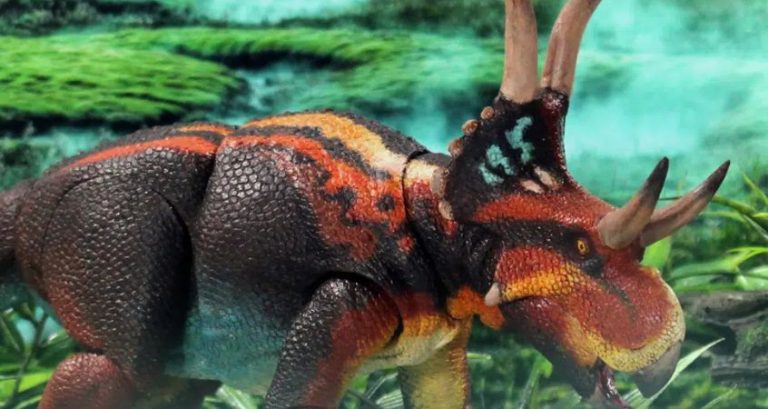
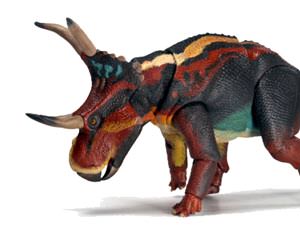
Numerous dinosaurs had horns and frills, including the Styracosaurus. This herbivorous dinosaur had spikes along its frill and a large horn just above the mouth. These dinosaurs also had a beak-like mouth that made it easy for them to grab and eat plants such as cycads or ginkgoes.
Moreover, the Styracosaurus had a large, bulky body like the modern-day rhino. They could grow up to 18 feet in length and weigh around three to four tons. Despite their intimidating appearance, Styracosaurus were likely peaceful creatures that lived in herds and used their horns for display or defense against predators.
Dino Fact
The Styracosaurus was a member of the Ceratopsia group, which means that it was related to other horned animals, such as the Triceratops.
It Lived in Herds
The discovery of bone beds of the Styracoaurus indicates that the species most likely traveled or lived in herds. Like other herbivorous creatures, traveling in herds would make migration safer since there’s strength in numbers. Living or traveling in herds could also make it easier for the species to find a mate and care for their young.
Size May Have Protected Them
Another amazing fact about the Styracosaurus is that its large size may have served as a natural defense. Although predators like the Albertosaurus lived alongside the Styracoaurus in what’s now Alberta, Canada, and Montana, USA, it’s unlikely the Albertosaurus hunted them.
An adult Styracoaurus was around 18 feet long and 6 feet tall, while the Albertosaurus was 30 feet long and 11 feet tall. While the Albertosaurus was larger, it wasn’t big enough to take down an adult Styracoaurus; however, they may have hunted baby Styracoaurus.
A Predator of the Styracosaurus
While their size may have deterred some beasts, it didn’t ward off all predators. Other beasts, such as the Daspletosaurus, may have hunted Styracoaurus since they were large and strong enough. If this predator came upon a herd of Styracoaurus, the Daspletosaurus likely picked out the slowest-moving or weakest dinosaur as their prey.
Shop for Dinosaur Action Figures
At Creative Beast Studio, we have beasts of the Mesozoic modeled after various dinosaurs, including this beloved spiked lizard. We carefully craft everything in our collection to ensure the dinosaur figures resemble their real-life counterparts. Add the Styracosaurus to your collection today!