
How Ancient Volcanoes Shaped Dinosaur Habitats
During the Age of Dinosaurs, our world was very different from what it is today, and like modern ecosystems, natural features impacted the environment. More specifically, volcanic activity had a profound impact on the world, shaping the landscape, influencing the climate, and creating land masses and natural barriers, all while providing fertile soil. Let’s explore how ancient volcanoes shaped the habitats of dinosaurs throughout the Mesozoic Era.
Altered the Climate
Technically, volcanoes release gases like CO? (carbon dioxide) whether they’re erupting or not. If the volcano is not erupting, then it releases those gases through vents, fumaroles, and cracks that are at and below the Earth’s surface. During an eruption, volcanoes release massive amounts of CO?, SO? (sulfur dioxide), water vapor, and other chemical compounds; they also release ash, which can block sunlight.
Gases such as CO? cause warming in an environment, while SO? causes short-term cooling. Moreover, water vapor traps greenhouse gases like CO?, keeping them in the atmosphere for longer periods. Together, this causes a short-term cool down, but over time, it can lead to the environment becoming hotter and humid from the CO? and water vapor molecules.
Created Land Masses
Another way ancient volcanoes shaped the habitats of dinosaurs was by creating islands, mountains, or plateaus. Volcanic eruptions also contributed to the continental growth over thousands to millions of years. Generally, the creation of islands or mountains takes several thousand years, whereas continental growth can take millions of years.
The formation of landmasses created new habitats, providing dinosaurs with more food and space to thrive. Likewise, volcanic eruptions created natural barriers such as mountains, which helped separate species from predators and competition.
Provided Fertile Land
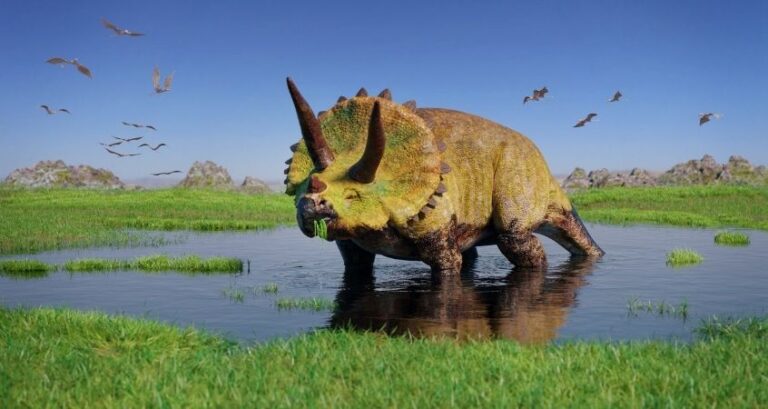
Most of us wouldn’t think dinosaurs would care about how fertile the land is, since it doesn’t seem like they’d have to worry about plant growth. However, a lack of greenery meant that herbivorous species like Triceratops or Brachiosaurus had no food, which would leave their predators with less food. No plants means the whole food chain falls apart.
Volcanic eruptions deposited nutrient-rich ash and lava, which prompted plants like ferns and conifers to grow in abundance. This led to a healthy population of herbivores, which then supplied food to carnivorous dinosaurs.
Ended Their Rule
While many of us know a meteor is what likely killed off the dinosaurs, it likely wasn’t the only cause. Paleontological evidence suggests that there was massive volcanic activity near the end of the Cretaceous period. The enormous release of SO? would cause short-term cooling, which made it harder for most species to survive. As explained, the CO? also made it harder to survive since it trapped heat, leading to massive climate swings.
It is likely that the uptick in volcanic activity at the end of the Cretaceous period introduced toxic gases into the atmosphere, which killed off animals and plants. This made the entire ecosystem more fragile, reducing survival rates.
Creative Beast Studio
Volcanic activity was a powerful and constant force throughout the Mesozoic Era, shaping the world the dinosaurs inhabited. If you’re inspired to bring a piece of this prehistoric majesty into your own home, explore the high-quality dinosaur figures at Creative Beast Studio. Create your own world forged by fire and bring your favorite dinosaur species to life.